
Most visitors stick to Duval Street for the sunset views, but a few miles offshore lies a quieter, submerged landscape. Eastern Dry Rocks, located about six miles southeast of Key West near Sand Key and Rock Key, remains one of the Lower Keys’ most accessible reefs.
This site is defined by its “spur-and-groove” formation. These are fingers of living coral separated by white sand channels. These natural corridors function like underwater canyons, creating an easy-to-navigate map for divers and snorkelers exploring the Florida Keys National Marine Sanctuary.
The Lay of the Land (and Sea)
Eastern Dry Rocks sits inside a Sanctuary Preservation Area (SPA) about a mile east of Sand Key Light. It’s a shallow bank reef, with depths ranging from 5 to 35 feet. You’ll spend most of your time averaging around 15 feet.
This specific topography creates a three-dimensional playground:
- For snorkelers: Coral heads rise close to the surface.
- For divers: Sandy “grooves” provide deeper lanes to cruise through.
- For marine life: Ledges and crevices offer endless hiding spots.
Because the reef sits slightly offshore, visibility is often excellent, with sunlight illuminating the sand channels below.
Snorkeling: Shallow, Bright & Easy to Navigate
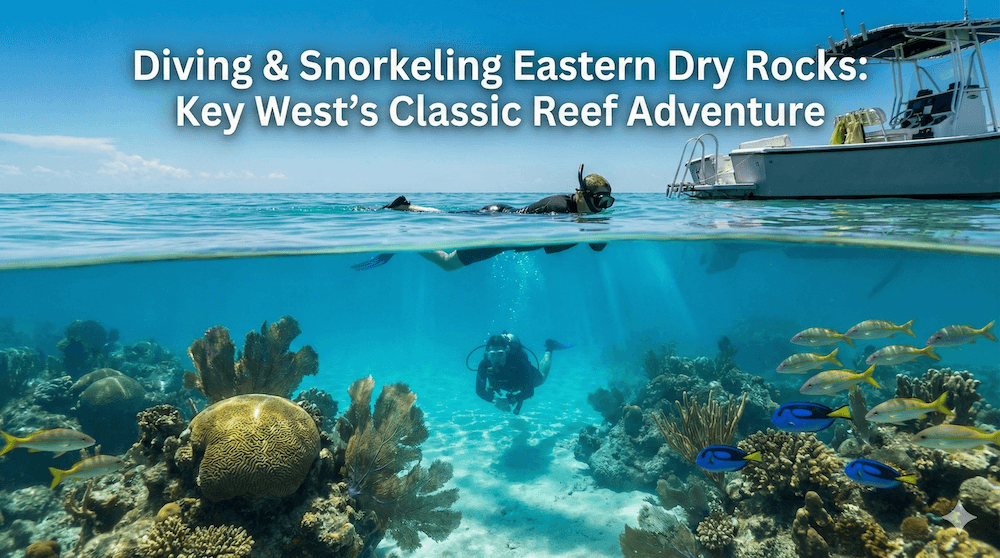
Eastern Dry Rocks is ideal for snorkeling because the reef comes up to meet you. With tops of coral heads often just 5–10 feet down, you don’t need to freedive to see the details.
On calm days, you can drift over brain corals, sea fans, and boulder corals while watching schools of yellowtail snapper, grunts, and blue tangs dart below.
Why it works for snorkelers:
- Beginner-Friendly: The shallow profile suits families and first-timers. You can often spot sleeping nurse sharks or grazing sea turtles without leaving the surface.
- Natural Navigation: The sand channels act like clearly marked trails. You can float along a groove and look sideways at the coral “walls” rather than just staring down from above.
- Accessibility: It’s a quick 30–45 minute boat ride from Key West.
A note on weather: Conditions dictate the experience here. While the reef is shallow, wind can chop up the surface and stir up sand, dropping visibility quickly. Check the marine forecast and aim for light winds.
Scuba Diving: Slow Drifts & Hidden History
While snorkelers handle the high ground, divers drop into the sandy grooves (20–35 ft). This isn’t a depth-charging adrenaline dive. It’s a high-light, long-bottom-time experience perfect for slowing down and hunting for macro life.
Who is this dive for? The gentle topography and generally mild currents make this a stress-free site for:
- Newly certified divers.
- Divers refreshing their skills after a break.
- Groups with mixed experience levels.
The “Invisible” Spanish Galleon
The southwestern corner of the reef holds the scattered remains of an old Spanish galleon. Don’t expect a Hollywood movie set with a pristine hull. The reef has largely reclaimed the ship over the centuries.
Instead, treat it like a treasure hunt. Eagle-eyed divers can spot ballast stones, brass fittings, old spikes, and encrusted artifacts hidden among the coral. It adds a layer of history to the dive, provided you know what to look for.
Marine Life: What You’ll Actually See at Eastern Dry Rocks
The coral fingers and sand channels concentrate marine life. This makes encounters frequent and varied.
The Heavy Hitters
- Nurse Sharks: Often found sleeping under ledges or cruising the sand flats.
- Spotted Eagle Rays: Look for them “flying” through the deeper sand grooves.
- Sea Turtles: Hawksbills and greens are regulars here.
- Summer Visitors: Tarpon, permit, and occasional goliath groupers often patrol the reef and wreck sites during warmer months.
The Reef Residents
Expect the standard colorful cast of the Keys: parrotfish, angelfish, wrasses, and sergeant majors. If you peek into holes and crevices, you’ll likely find green moray eels, spiny lobsters, and small octopuses. Occasionally, guides report hammerheads passing along the deeper edges of the reef.
Conservation & Recovery of the Reef
It is vital to manage expectations regarding the coral itself. Like much of the Florida Reef Tract, Eastern Dry Rocks has suffered from disease, storms, and recent marine heat waves (specifically the 2023–2024 bleaching events). Long-time visitors will notice a reduction in coral cover compared to decades past.
However, this site is a focal point for recovery. It is one of NOAA’s seven “Mission: Iconic Reefs” sites, designated for massive restoration efforts. You aren’t just diving a reef. You are swimming through an active conservation laboratory. You will likely see:
- Outplanted elkhorn and staghorn corals.
- Active work by non-profits like Mote Marine and the Coral Restoration Foundation.
- Divers maintaining restoration plots by clearing algae.
What Recent Divers & Snorkelers Say
Feedback from diving communities creates a consistent picture:
- Manage Expectations: If you are used to Cozumel or even the deeper reefs of Key Largo, Eastern Dry Rocks might feel “flatter.” It’s a patch reef, not a dramatic wall dive.
- Reliable for Beginners: Even critics agree it’s a fantastic, low-stress site for students and casual diving.
- Bleaching Reality: Recent reports confirm visible bleached or dead coral, particularly around shallow outplant sites.
- Summer Trade-off: Summer offers the calmest seas and clearest water, but you have to contend with the heat and humidity on the boat ride.
Rules & Etiquette
Because this is a Sanctuary Preservation Area (SPA), strict rules apply to keep the reef healthy:
- No-Take Zone: No fishing, spearfishing, lobstering, or shell collecting.
- Mooring Only: Anchoring on the reef is prohibited. Use the provided mooring buoys.
- Look, Don’t Touch: Keep hands and fins off the coral.
Pro Tip: Use reef-safe sunscreen (or wear a rash guard), and never chase marine life for a photo.
Planning Your Trip
- Access: Boat only. Most Key West charters run trips here regularly.
- Best Season: Spring through early summer offers the best balance of warm water and manageable winds. Winter diving is great but requires a wetsuit and flexibility regarding cold fronts.
- Trip Combos: Charters often combine Eastern Dry Rocks with nearby Sand Key or Rock Key, giving you two distinct underwater landscapes in a single half-day trip.
Packing List:
- Mask, snorkel, fins (rentals usually available).
- Reef-safe sunscreen.
- Rash guard or light wetsuit (essential in winter, helpful for sun protection in summer).
- Underwater camera (the shallow depth provides excellent natural light).